
 EN
 Polski
 Deutsch
 Nederlands
 Français
 Español
 Italiano
 Português
 Română
 Svenska
 Dansk
 العربية
 Čeština
How to Measure Pants and Shorts Before Choosing a Kakobuy Size
Compare the waist, rise and leg measurements together, and learn what to do when only some of them match.
A pair of trousers can match your waist and still be wrong through the seat, too short in the leg or too narrow over your shoes. Before choosing a Kakobuy size, compare the measurements of a pair you like wearing with the exact seller option you are considering.
A number and a letter can both be size labels
These three entries in the Pants & Shorts collection use different size menus. Their labels help you identify an option; they do not establish its measured dimensions.
Swipe across the table to see every column. With a keyboard, focus the table and use the arrow keys.
| Example | Recorded options | Still needed for a fit comparison |
|---|---|---|
| Purple Brand distressed jeans | 28, 29, 30, 31, 32, 33, 34, 36, 38, 40 | The selected size’s garment measurements and units. Do not read “28” as a verified 28-inch waist. |
| N69 blue jeans | S, M, L, XL, XXL | Waist, rise, leg length and opening for this option. “S” does not provide a conversion from the numeric menu above. |
| 724 black drawstring shorts | S, M, L, XL | Relaxed waist, an explanation of any stretch figure, rise, inseam and outseam. |
If the seller supplies a chart, first ask whether “waist” means a flat garment width, a garment circumference or a recommended body measurement. Converting inches to centimetres will not fix a comparison between those different quantities. One inch equals 2.54 cm; keep the unit beside every number.
Choose a pair that fits the way you want this one to fit
Try on your reference pair first. Note where its waistband sits, whether you have enough room when sitting, and where the hem falls with the shoes you intend to wear. A low-rise pair and a high-rise pair sit at different places on your body, so an equal waistband width does not settle the fit.
Use jeans to compare with jeans where possible, and relaxed shorts with a similar waistband to compare with elastic shorts. A loose pair that stays up only because you tighten the drawcord is a poor reference for a fixed-waist trouser. If your reference itself pinches or drags, write that down instead of treating all its measurements as targets.
- Take the garment off, empty the pockets and close its button, hook or zip. Loosen any drawcord and unfold turned-up hems.
- Lay it on a flat surface and smooth folds without stretching the fabric. Keep the front and back waistband arrangement visible in your photo.
- Record whether the reference has been washed, worn since washing or altered. Ask about the candidate’s stated wash condition; do not assume it will shrink or stretch into the required size.
Measure the waistband and the rise as separate checks
Fixed waist: state how the waistband was arranged
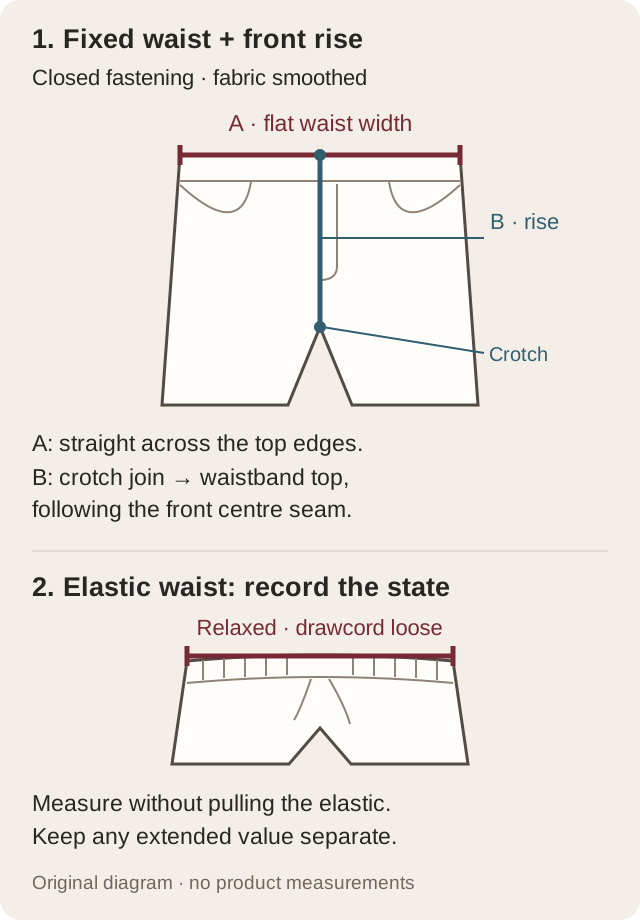
With the fastening closed, measure straight across the top from one outside edge to the other. Note how you positioned the front and back edges: some methods align them, while others leave the waistband lying naturally. A curved band may not lie straight without changing its shape. Send a photo of your arrangement and ask the seller to use the same method.
Double a flat width only when you need an approximate garment circumference from that method. It is not a measurement around your body or a guaranteed recommended body size. A contoured waistband or uneven front and back can make that shortcut less useful.
Measuring instructions can differ. For example, Blue Owl’s denim measuring guide aligns the front and rear waistband edges under tension (consulted September 28, 2026). That is a stated method for its measurements; check the method used by your chosen seller rather than mixing a pulled measurement with a relaxed one.
Elastic waist: one relaxed number cannot describe the stretch
Leave the drawcord loose and let the waistband settle before measuring across it. Label the result relaxed flat waist width. If the seller also supplies an extended width, ask how far the band was pulled and request a separate photo. A number recorded at an unexplained amount of tension is hard to reproduce.
A maximum stretch figure does not tell you what will feel comfortable around your waist. The drawcord can tighten the waist, but it does not add room to the seat or thigh. If those areas feel restrictive in your reference, request their measurements at agreed positions too.
Front rise: keep the crotch join and waistband top visible
Find the join of the crotch seams. Follow the front centre seam up to the top edge of the waistband, including the band, with a flexible tape resting on the fabric. If a seller measures only to the seam below the band, ask for the band height or repeat that shorter method on your reference; keep the two results clearly named.
Front rise helps compare the construction above the legs. It cannot by itself predict where the trousers will sit when worn. If your concern is pulling across the seat or a low back waistband when sitting, ask for back rise and seat width as well, with the measurement positions shown.
Separate inseam, outseam and leg opening
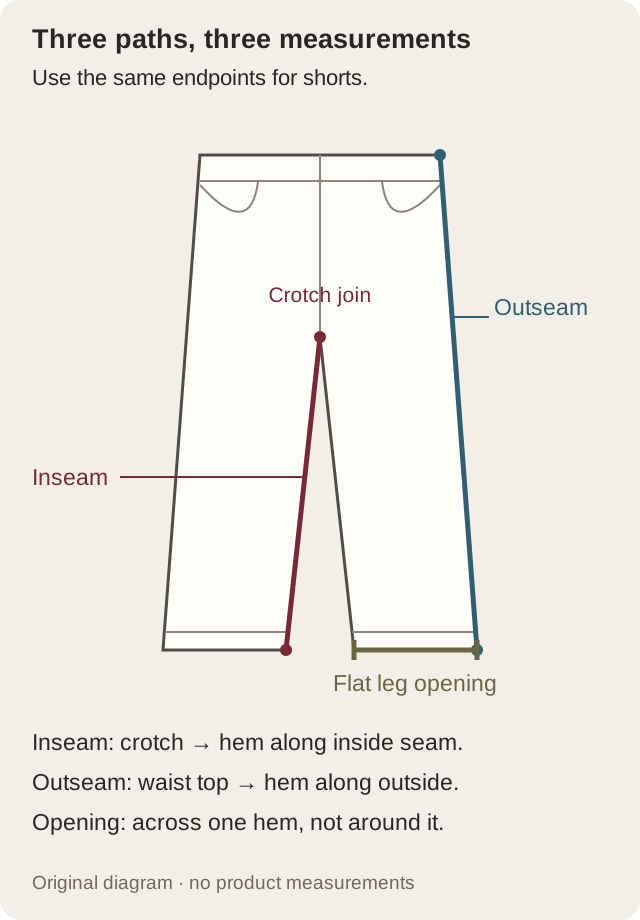
- Inseam: lay one leg flat and follow the inside seam from the crotch join to the finished hem edge. Keep the tape against the seam without stretching the leg. Show where you started if there is a crotch gusset instead of a single join.
- Outseam: measure from the top of the waistband down the outside seam to the finished hem, including the band. If there is no side seam, agree on the outside path and show it in a photo.
- Flat leg opening: smooth one hem and measure straight across it, edge to edge. This is the width of one opening, not its circumference or the width of both legs together. For an elastic cuff, label its state separately.
For shorts, an outside length alone leaves the crotch position unresolved. Two pairs can have similar outseams but different rises and inseams. Do not calculate the inseam by subtracting front rise from outseam: those paths do not run along the same line.
For jeans, consider inseam and opening together with your reference pair over your usual shoes. A wider hem can fall differently from a narrow one at the same inseam. If you want a flare or bootcut, request knee width at a specified distance below the crotch as well as hem width; the product title alone does not establish the shape.
What if the waist matches but the length does not?
First confirm that both numbers use the same units, endpoints and garment state. Then decide which difference matters to how you want to wear the pair.
- Waist close to your reference, inseam too short: ask whether a longer length exists in that waist size. Check an adjacent size’s full measurements before moving up; a longer leg may come with an unwanted change in waist, seat or rise.
- Waist suitable, jeans too long: ask about a shorter option first. If considering alteration, a tailor needs to assess the construction. Shortening a flared leg can change its final opening or remove hem details; do not assume hemming preserves the look.
- Relaxed shorts waist narrower, extended waist wider than your reference: you still lack a comparable tension measurement. Ask how the extended value was taken and check the seat and thigh. Being inside a quoted stretch range is not proof of comfortable fit.
- Waist and inseam close, rise substantially different: do not average the differences away. Compare waistband position and request back-rise or seat measurements if those are the concerns. Another cut may suit you better than another size of the same cut.
If a small difference decides the purchase, ask for the seller’s measurement tolerance and a clear photo rather than treating the chart as exact. Keep unprovided values marked as missing. Choosing neither candidate is a valid outcome when neither supplies the proportions or evidence you need.
Ask about the exact style and size you intend to order
Attach the product link and selected option image.
For my selected style and size, please provide flat waist width with the fastening closed, front rise from the crotch join to the waistband top, inseam to the finished hem, and flat width across one leg opening, in centimetres. Please show how the front and back waistband edges are arranged. If your chart uses different points, could you show its measuring method?
For 724 black shorts in L, change the waist request to relaxed flat width with the drawcord loose, add outseam including the waistband, and ask separately how any extended waist figure is measured. Do not reuse the jeans’ fixed-waist instructions without that change.
For photos, ask for the tape’s zero mark, the garment’s start point, the full path and the endpoint in the same view. Confirm availability and any charge before requesting extra warehouse work. When your own order arrives, match the option and size first, then compare its measurement photos using the same method. The QC next-step checklist helps separate an unreadable photo from a measurement that disagrees with your order.
Return to the jeans, cargo and shorts comparisons to choose a cut. For a matching set, measure the top separately with the top measurement tutorial; the Nike set sizing notes explain why both pieces need their own check. Once the option questions are resolved, follow the Kakobuy buying steps.