
 EN
 Polski
 Deutsch
 Nederlands
 Français
 Español
 Italiano
 Português
 Română
 Svenska
 Dansk
 العربية
 Čeština
Chinese Sizes vs US, UK and EU Sizes: How to Find Your Size on Kakobuy
A Chinese M is often not your M. Convert jin and centimetres, find your row in a real size menu and confirm with measurements.
A Chinese seller’s M is often not the M you buy at home. Many size menus on Kakobuy describe each size with a suggested body weight, often in jin (斤), and sometimes with a height in centimetres. This guide shows what those sizes usually mean in kilograms and pounds, how to convert the units, and how to confirm a size with measurements.
There is no official chart that turns a Chinese letter size into a US, UK or EU letter size. Letter sizes differ between brands in every country. Use the figures below as a starting point, then check the measurements of the exact item.
Why Chinese sizes usually run small
We looked at clothing size menus in our catalog that give a weight for each letter size. For each size, we took the middle of the seller’s suggested weight range. The table shows the typical value and the range covering the middle half of those options.
Swipe across the table to see every column. With a keyboard, focus the table and use the arrow keys.
| Seller’s size | Typical suggested weight | Middle half of suggestions |
|---|---|---|
| S | 50 kg (110 lb) | 45–55 kg (99–121 lb) |
| M | 55 kg (121 lb) | 51–62.5 kg (113–138 lb) |
| L | 65 kg (143 lb) | 59–72.5 kg (130–160 lb) |
| XL | 75 kg (165 lb) | 65–82.5 kg (143–182 lb) |
| XXL | 82.5 kg (182 lb) | 75–90 kg (165–198 lb) |
| 3XL | 85 kg (187 lb) | 79–94 kg (174–207 lb) |
So a seller’s M is most often suggested for someone around 55 kg (121 lb), and XL for around 75 kg (165 lb). If you usually wear M in Europe or the US and weigh more than that, your starting point in these menus is likely to be L, XL or larger.
These are sellers’ suggestions about the wearer, not garment measurements. Neighbouring sizes overlap a lot, and most listings in our catalog give only a letter, with no weight at all. The table tells you where to start looking, not which size will fit.
Convert jin, kilograms, pounds and height
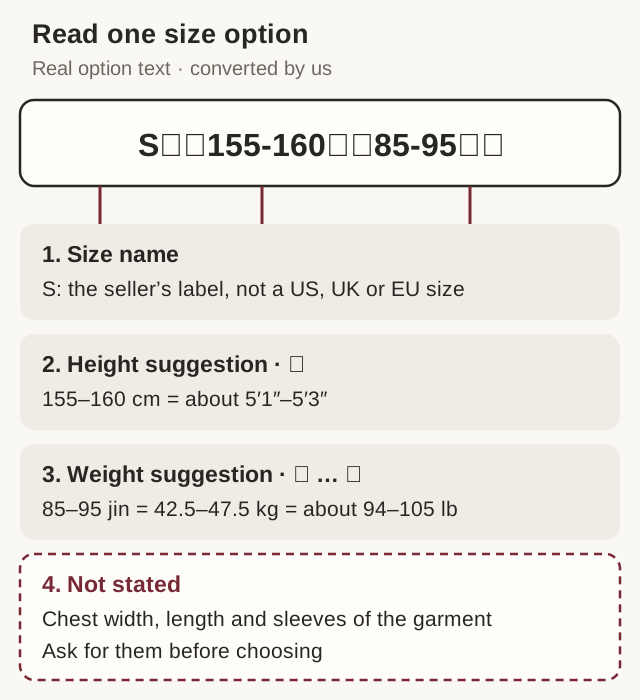
1 jin (斤) = 500 g = 0.5 kg. To get kilograms, halve the jin figure: 120–140斤 is 60–70 kg. Chinese market units were kept on a metric basis by a 1959 State Council order; see jin (mass) for background. Some menus use kg instead, so check the unit after each number. 80–100斤 and 80–100 kg are very different sizes.
For pounds, one pound is exactly 0.45359237 kg and one inch is exactly 2.54 cm, as listed in NIST Handbook 44. One stone is 14 lb. The values below are rounded.
Swipe across the table to see every column. With a keyboard, focus the table and use the arrow keys.
| kg | lb | stone | jin (斤) |
|---|---|---|---|
| 50 | 110 | 7 st 12 lb | 100 |
| 55 | 121 | 8 st 9 lb | 110 |
| 60 | 132 | 9 st 6 lb | 120 |
| 65 | 143 | 10 st 3 lb | 130 |
| 70 | 154 | 11 st 0 lb | 140 |
| 75 | 165 | 11 st 11 lb | 150 |
| 80 | 176 | 12 st 8 lb | 160 |
| 85 | 187 | 13 st 5 lb | 170 |
| 90 | 198 | 14 st 2 lb | 180 |
| 100 | 220 | 15 st 10 lb | 200 |
Heights are almost always in centimetres. 高 means “height” and 身高 means “body height”.
Swipe across the table to see every column. With a keyboard, focus the table and use the arrow keys.
| cm | ft and in |
|---|---|
| 160 | 5′3″ |
| 165 | 5′5″ |
| 170 | 5′7″ |
| 175 | 5′9″ |
| 180 | 5′11″ |
| 185 | 6′1″ |
| 190 | 6′3″ |
Find your row in the seller’s size menu
Size menus are written by each seller, so the same letter can mean different things on different listings. These menus come from current listings in our catalog. The original text is kept as the seller wrote it.
Swipe across the table to see every column. With a keyboard, focus the table and use the arrow keys.
| Example | Size menu (original text) | What it tells you |
|---|---|---|
| Navy lightweight hooded jacket | S(高155-160,重85-95斤) · M(高160-165,重90-105斤) · … · 2XL(高175-180,重140-155斤) · 3XL(高175-180,重155-170斤) · 最后一张有尺码表 | Height (高) and weight (重) per size. S is 42.5–47.5 kg and M is 45–52.5 kg, so the ranges overlap. 2XL and 3XL share the same height range. The last entry is a note: “the last photo has a size chart”. |
| Deep khaki long quilted coat | 155 (建议90-115斤) · 160 (建议115-135斤) · 165(建议135-155斤) | The sizes are named after a height in centimetres. 建议 means “suggested”: 45–57.5 kg, 57.5–67.5 kg and 67.5–77.5 kg. |
| Grey tracksuit set | M-100-120斤 · L-120-140斤 · XL-140-160斤 · S 80-90斤 | S is listed last. It stops at 45 kg and M starts at 50 kg, so no size is suggested for 45–50 kg. |
| Long sleeve grey top | 2码/S · 4码/M · 6码/L · 8码/XXL · 10码/XXXL | 码 means “size”. The seller pairs its own numbers with letters, and the menu goes from L straight to XXL. |
| Light wash flare jeans | S(28码) · M(30码) · … · XXL(36码) | The numbers look like waist sizes, but no unit is given. Do not read 28码 as a confirmed 28-inch waist. |
Convert your weight to jin, and your height to centimetres if the menu gives one. Then find the row that contains both. Two situations need more care:
- You fall into two rows. At 46 kg (92斤) you are inside both S and M on the hooded jacket. Choose by the fit you want and your build: a broad chest or a looser fit points to the larger size. Then compare garment measurements before deciding.
- You fall between rows. At 47 kg (94斤) there is no suggested size on the tracksuit. Do not guess. Ask for the measurements of both neighbouring sizes.
Read every entry in the menu, not only the sizes. A line such as 最后一张有尺码表 means the seller has put a size chart in the listing photos. Read that chart before you choose.
Confirm with measurements, not letters
A weight range describes a person. It cannot tell you how wide or long the garment is. To compare like with like, use a garment you already own:
- Choose a similar item that fits the way you want this one to fit, such as a hoodie for a hoodie or jeans for jeans.
- Lay it flat and measure it: chest width and length for tops; waist, rise and inseam for trousers. The top measurement guide and pants and shorts guide show the measuring points. For shoes, see shoe sizing.
- Write down each number in centimetres. Sellers almost always reply in centimetres; 1 inch is 2.54 cm.
- Ask for the same measurements for the exact style and size you are considering, and compare them with yours.
Attach the product link and the selected option when you ask:
For this style in size [size], please give the flat chest width, the front body length from where the shoulder seam meets the collar down to the hem, and the sleeve length, in centimetres. If your chart uses different measuring points, could you show how it was measured?
When your item reaches the warehouse, check that its label matches the size you chose. A matching label confirms the size name, not the measurements. How to read QC photos explains the difference.
When “size up” is a fair starting point — and when it isn’t
The data supports a simple rule of thumb: in Chinese size menus, buyers used to European or US sizes usually need a larger letter than at home. Use it to decide which sizes to ask about, not as the final answer.
- Oversized or relaxed cuts are already cut large. Sizing up again may give you more length and sleeve than you want.
- Stretch fabrics such as knit tops or compression wear can fit across more than one size. Check the length, which does not stretch.
- Outerwear worn over a hoodie or knit needs more room in the chest and sleeves. Measure your reference coat over the same layers.
- A menu with no weight or height leaves you nothing to convert. Ask for measurements first.
If neither neighbouring size matches your reference garment, choosing another listing is a reasonable outcome. For outerwear examples, see the jackets and coats collection. When you have settled on a size, follow the Kakobuy buying steps.